
TECHNOLOGY · WORK · JUDGMENT
Relax. You will still be relevant.
The tools will change. Your understanding of the problem, and your judgment about what to do next, will matter even more.
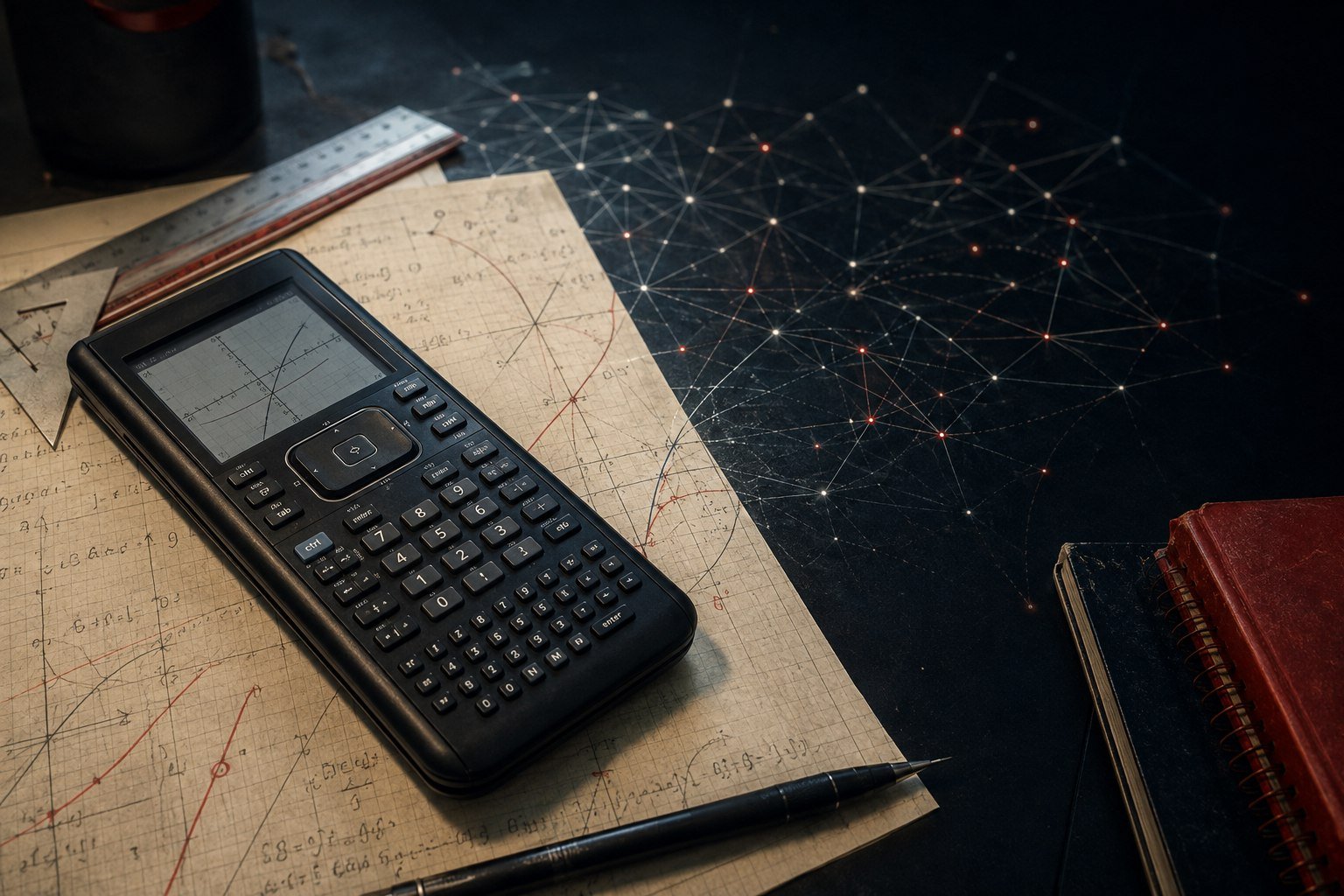
When I was at university, we had the Texas Instruments Nspire. Around 2013, it cost approximately $230, which was expensive for a calculator. At the time, it felt like one of the most powerful tools a student could own.
The calculator everyone wanted
It could solve complicated equations, graph functions, calculate derivatives, draw tangent lines, work with variables, and automatically update results when values changed. It could complete in seconds calculations that would take a student much longer to do manually.
You might assume that owning such a powerful calculator made mathematics easy.
It did not.
I still found many exams extremely difficult. I still struggled to understand certain questions, and I even failed a couple of courses.

Calculation is not understanding
The calculator was powerful, but it could not decide what the professor was asking. It could not tell me which formula I should use unless I understood the problem first.
It could not recognize every mistake I made while entering the information. It could give me a technically correct answer to the wrong question, and unless I understood the subject, I might not even notice.
The tool could calculate, but it could not understand the situation for me.
That is exactly how we should think about artificial intelligence.
People are worried that AI will suddenly make their education, experience, creativity, or professional skills irrelevant. But access to a powerful tool has never automatically made someone competent.
Having Photoshop does not make someone a designer.
Having a professional camera does not make someone a photographer.
Having access to Google does not make someone a researcher.
Having a calculator does not make someone a mathematician.
And having access to AI does not automatically make someone intelligent, creative, strategic, or skilled.
The work behind the answer
AI can generate text, analyze information, write code, summarize documents, create images, and suggest solutions. But it can also misunderstand the request, invent information, miss important context, repeat bias, or confidently produce something completely wrong.
The quality of the result still depends heavily on the person using it.
You need to know how to describe the problem clearly. You need enough knowledge to ask the right questions. You need curiosity to explore different possibilities.
You need experience to recognize when an answer is unrealistic. Most importantly, you need judgment to decide what should actually be used.

That is where your value remains.
Judgment is the difference
Your value is not simply your ability to complete a task manually. Your value is your understanding of why the task matters, how it should be approached, what could go wrong, and what a good result should look like.
Two people can use the same AI system and receive completely different results.
One person will accept the first answer without questioning it. Another will challenge it, refine the instructions, test its limits, verify the information, and turn the rough output into something meaningful.
The difference is not the AI.The difference is the person using it.
A job is more than a list of tasks
AI will probably automate parts of many jobs. Some repetitive tasks will become faster, cheaper, or unnecessary. Pretending otherwise would be dishonest.
But jobs are rarely just a collection of isolated tasks. They also involve communication, responsibility, decision-making, relationships, creativity, context, ethics, and accountability.
AI can offer a recommendation, but a human still has to own the consequences.
It can generate possibilities, but a human must decide which possibility fits reality.
It can imitate patterns from the past, but people still have to determine what the future should look like.

Keep your ability to think
So do not waste your energy trying to compete with AI at doing everything manually. Learn how to work with it. Explore what it can do, discover where it fails, and understand how it behaves under different instructions.
Use it to remove repetitive work so you can spend more time thinking, creating, deciding, and solving the problems that actually require you.
Your existing skills are not becoming worthless. They are becoming the foundation that allows you to use AI properly.
The better you understand your profession, the better you can direct the technology. The more experience you have, the faster you can detect nonsense. The stronger your judgment is, the more useful AI becomes in your hands.
The future will not simply belong to AI.
It will belong to people who understand their field, know how to use AI, recognize its limits, and refuse to surrender their own ability to think.